
by Clear Path Intervention
Share
by Clear Path Intervention
Share

You married this person. You made vows. You built a life together, possibly a family, a home, a shared future that once felt completely secure. And now you are lying awake at 2 a.m., listening for the sound of the car in the driveway, calculating how many drinks they have had from the evidence in the recycling, or checking their phone for signs of pill purchases, and you are wondering whether the person you fell in love with still exists somewhere inside the one you are living with.
Intervening with a spouse or intimate partner is among the most emotionally complex situations in the field of professional intervention. The power dynamics, the financial entanglement, the children, the love, the grief, the rage, all of it is present in the room simultaneously. And yet, it is also one of the most important interventions we conduct, because the stakes are not just one life. They are an entire family’s future.
Why Spouses Wait and Why Waiting Is Dangerous
The hope that it will get better on its own
Spouses are uniquely positioned to see both the worst of the addiction and the best of the person they know their partner to be. In a moment of clarity, a romantic evening, a good parenting moment, a brief period of reduced use, hope revives. ‘Maybe this is the turning point.’ This oscillation between hope and despair is one of the primary mechanisms that keeps spouses from seeking professional help long after the clinical threshold for intervention has been crossed.
Financial dependency and practical fear
Many spouses, particularly in households with a primary earner whose addiction is driving the family’s financial instability, face a genuine practical calculus: ‘If I force this issue, what happens to our income, our health insurance, our mortgage?’ These are not irrational fears. They are real considerations that a professional interventionist must help the family navigate as part of the intervention planning process.
The children’s question
When there are children in the home, spouses often feel caught between two impossible positions: staying in a chaotic, addiction-affected household for the sake of family stability, or forcing a confrontation that might destabilize the family further. The clinical reality is that children raised in homes with active, untreated addiction suffer measurable psychological harm regardless of whether the family stays intact. The most protective thing a sober parent can do for their children is to seek help for the addicted parent now.
The Unique Clinical Considerations of a Spousal Intervention
Power dynamics and manipulation
Intimate partnerships create leverage that does not exist in other relationships. A spouse who is actively using may have long since learned, consciously or not, precisely which emotional buttons to press to prevent an intervention from moving forward. Guilt about the marriage, threats about custody or finances, emotional displays designed to redirect concern, these are common defensive responses from a partner in denial. A professional interventionist anticipates and prepares the family for these dynamics.
The co-occurring codependency dynamic
It is important to name this plainly: spouses of addicted individuals very frequently develop their own psychological responses, anxiety, hypervigilance, people-pleasing, and enabling behaviors that are clinically significant and that must be addressed as part of the intervention process. We call this the ‘family system’ dimension of addiction, and it is why we offer family recovery courses alongside our professional intervention services. The goal is not to blame the sober spouse; it is to give them the tools to stop inadvertently sustaining a cycle that is harming everyone.
Children as intervention participants
This requires careful clinical judgment, but in some situations, particularly where adolescent children have been directly and significantly affected, including them in the intervention can be powerfully motivating for the addicted parent. Nothing cuts through denial like hearing your own child describe what it feels like to be afraid of you. This decision is made only with the interventionist’s guidance, never unilaterally by the family.
Preparing for the Possibility of a No
A spousal intervention that does not result in immediate treatment acceptance is not a failure, but it does require the sober spouse to be prepared for what comes next. Boundaries established during the intervention must be maintained even if the addicted partner refuses treatment on the intervention day. This is where many spousal interventions lose their effectiveness: the sober partner, exhausted and heartbroken, agrees to ‘give it one more chance’ and dismantles the structure that was designed to create real consequences.
We work with spouses to distinguish between genuinely sustainable consequences and those that are stated in the heat of emotion but cannot be maintained. A consequence that is stated but not followed through is worse than no consequence at all; it communicates that the status quo is ultimately acceptable.
What Recovery Looks Like for a Marriage
When a spousal intervention succeeds, and the addicted partner enters treatment, the work for the marriage is just beginning, not ending. Treatment addresses the individual’s addiction. It does not automatically repair a marriage that has been living in the shadow of active addiction, possibly for years.
Couples therapy, concurrent with or following individual treatment, is an essential component of spousal recovery. Betrayal trauma, broken trust, and the psychological adaptations the sober spouse developed to survive the addiction all need direct clinical attention. Many couples emerge from this process with a fundamentally different and, in time, stronger relationship. Others discover that the relationship itself was not sustainable beyond the addiction that was holding it together. Both outcomes are valid, and both can be navigated with appropriate clinical support.
Contact Clear Path Intervention today at (850)-563-9776 for a confidential consultation. Let’s build a plan that brings your loved one home.
HELP IS AVAILABLE
Do You Have a Loved One Struggling with Addiction or Mental Health Issues?
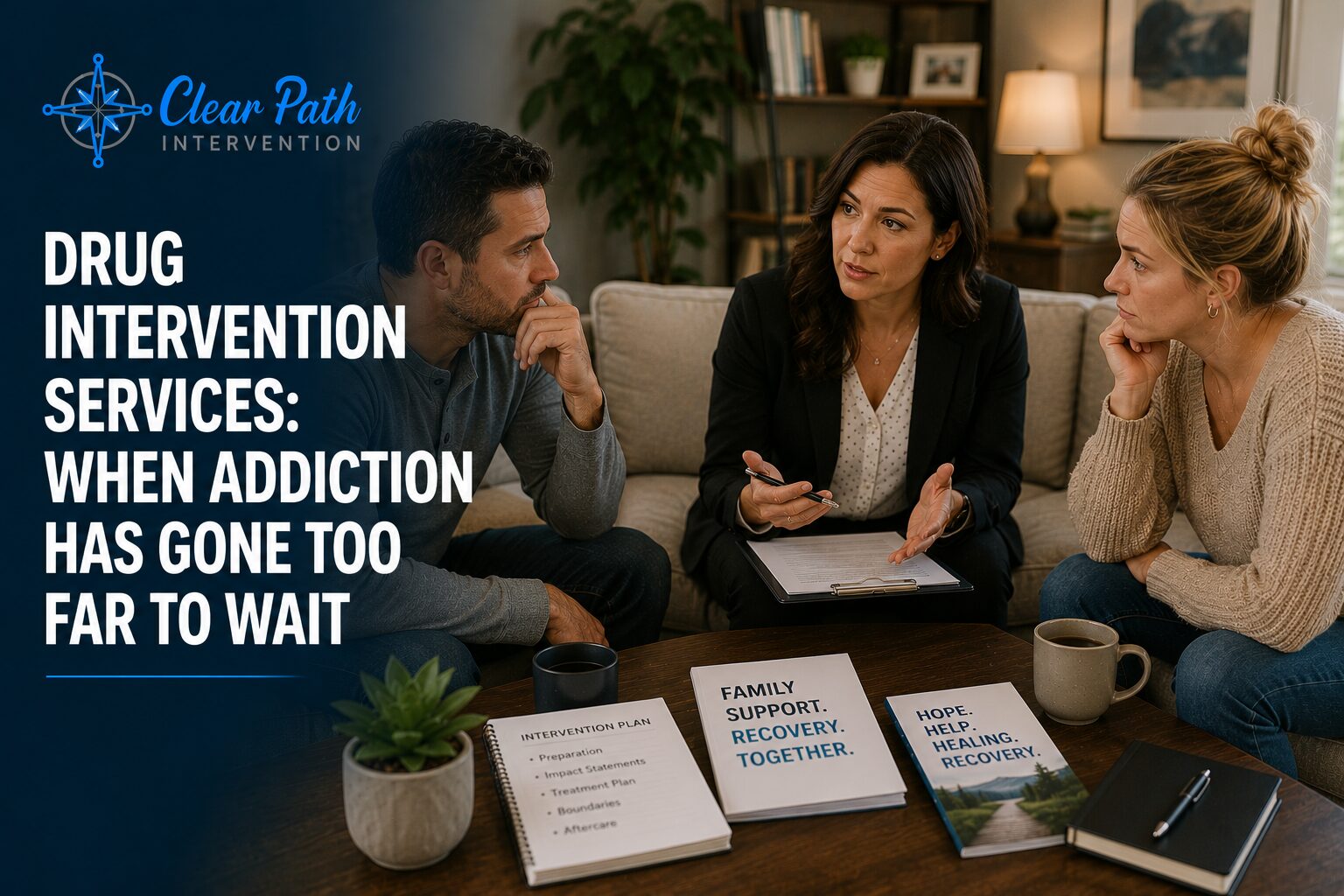
There is a particular kind of exhaustion that comes from loving someone whose drug addiction has taken over their life. You have had the conversations. You have made the threats — and not followed through. You have set boundaries — and let them slip. You have searched online at 2 a.m. and closed the laptop […]

When a family is in crisis — when a loved one’s addiction has reached the point where something has to happen — the pressure to act quickly can make it hard to think clearly about who to call. The intervention field is largely unregulated. Anyone can call themselves an interventionist. The quality of services ranges […]

Families who are new to this process often have a narrow picture of what a professional intervention service involves. A specialist shows up, talks to the family for a bit, sits in the room during the conversation, and leaves. That picture is missing most of what actually happens — and most of what makes the […]

Families who are new to the process of addressing a loved one’s addiction often use the words “intervention” and “treatment” interchangeably. It is an understandable confusion. Both are part of the path toward recovery. Both involve professionals. But they are not the same thing, and confusing them can delay getting the right kind of help […]